The importance of dates
The most dangerous number on a hospitality development is the one that does not appear on the construction budget. Every developer tracks the capital cost of the building — the concrete, the steel, the FF&E line, the contractor's progress claims. Far fewer track, with the same discipline, what the project costs per day in the window between structural completion and the first paying guest. That number is the burn rate, and it is silent because nothing about it looks like a crisis while it is happening. The building is up. The team is hired. Everyone is busy. And yet capital is draining out of the project at a rate that, left uncontrolled, can consume the entire pre-opening budget and start eating into the operating reserve before a single room has generated revenue.
The mechanism is almost always the same, and in the Indonesian development market it is sharpened by local realities that developers from more predictable markets consistently underestimate. A hotel pre-opening setup is not a phase that begins when construction ends; it is a phase that must be run in parallel with the tail of construction, and the handover between the two is where the money dies. Construction crews and operations teams work to different clocks, different incentives, and different definitions of "finished." The contractor's job is done when the building is handed over. The operator's clock started months earlier, sized against a completion date the contractor is now going to miss. When those two timelines fall out of alignment — and in Indonesia, between permitting friction, import delays, and monsoon-season schedule slippage, they almost always do — the operation is left fully staffed and fully committed, waiting on a building that is not ready. That gap, measured in weeks and multiplied by a loaded payroll and idle capital, is the silent burn. De-risking it is not a soft advisory exercise. It is a numbers race against the critical path.

The Three Major Capital Leaks
Pre-opening capital does not leak randomly. It leaks in three specific places, and each one is predictable, quantifiable, and preventable with disciplined sequencing. A senior project manager protecting the budget watches all three like instruments on a dashboard.
- Misaligned procurement timelines strand expensive capital in a warehouse while it depreciates. Kitchen equipment, operating supplies and equipment (OS&E), and FF&E have long lead times, and in Indonesia, those lead times are compounded by import duties, customs clearance, and shipping windows that do not accommodate optimistic planning. The instinct is to order early to avoid delay. The trap is ordering early against a construction schedule that then slips. Now hundreds of thousands of dollars of specialised equipment sits in storage — accruing warehousing costs, exposed to humidity and handling damage, with warranties ticking down before the equipment is ever energised — while the space it was bought for is still a construction site. Capital committed to inventory that cannot be installed is capital that has been switched off; it earns nothing, protects nothing, and quietly degrades. Procurement that is not sequenced tightly to the real construction milestones, rather than the optimistic ones, converts a cash asset into a depreciating liability.
- Premature hiring puts a full payroll on the clock before the building can support a single day of live training. The pressure to recruit early is real — a luxury property needs a trained brigade, and training takes time. But onboarding a full operational team before the site is structurally ready to host them is one of the fastest ways to burn pre-opening capital with nothing to show for it. Staff arrive at a property with no functioning kitchen to train in, no live systems to learn, no rooms to practice service in — so the organisation pays fully-loaded salaries for weeks of classroom theory and idle time that could have been compressed into a fraction of the window with correct sequencing. Every week a complete team is paid to wait is payroll spent purchasing nothing, and when the construction delay extends — as it does — that idle payroll compounds directly against the reserve. Hiring must be phased against genuine site-readiness milestones, not against a hopeful opening date printed at the start of the project.
- The absence of a structured hyper-care system turns the soft launch into a reputational liability. The days around opening are the single most fragile window in an asset's entire life. Systems are new, staff are green, and the coordination between departments has never been tested under real guest load. Without a deliberate, pre-planned hyper-care framework — the intensive, over-resourced support structure that catches failures before a guest experiences them — the soft launch becomes an uncontrolled experiment run in front of paying customers, review platforms, and the travel press. A chaotic opening does not just cost money in comped stays and service recovery; it permanently prices the asset's early reputation, and in a market where a property's first ninety days of reviews shape its rate positioning for years, that reputational damage is a capital loss disguised as a customer-service problem.
These three leaks share a single root cause. None of them is a failure of effort or talent. Each is a failure of sequencing — of coordinating procurement, payroll, and launch against the real timeline rather than the wished-for one.
The Strategic Fix
The structural solution is to stop treating pre-opening as the back end of construction and start treating it as a distinct discipline with its own command. The single most consequential decision a developer makes in this phase is whether to separate physical construction management from operational implementation, and to resource each with dedicated, accountable leadership.
The logic is not organisational preference; it is risk management. Construction management and operational implementation optimise for different outcomes and answer to different definitions of success, and when one party is asked to carry both, the operational side is invariably subordinated to the concrete. Separating them installs an operational authority whose entire mandate is to protect the pre-opening budget and de-risk the critical path — someone whose job is precisely to hold procurement, hiring, and launch in disciplined sequence against construction reality. In practice, effective hospitality project management in Indonesia does several things at once:
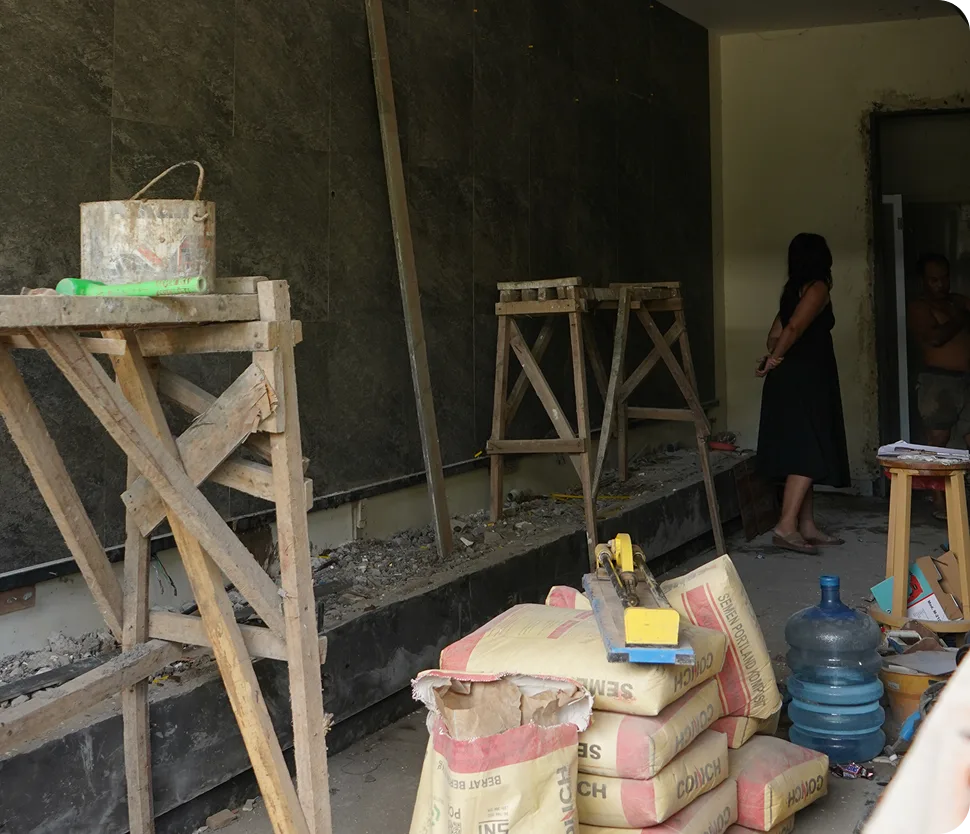
- It sequences procurement against verified construction milestones rather than the master schedule's optimistic dates, so that expensive equipment arrives when the space is ready to receive it, not months before, protecting both the capital and the warranty clock.
- It phases recruitment and training to genuine site-readiness gates, compressing idle payroll and ensuring the team's most expensive learning happens in a functioning building rather than an empty shell.
- It builds the hyper-care framework before opening rather than improvising it during, so the soft launch is a controlled ramp with the support structure to absorb failure quietly, protecting the asset's most valuable and most fragile commodity — its opening reputation.
- It maintains a single, real-time view of the critical path where procurement, construction, and operational readiness are tracked against one another, so that when construction slips, the operational commitments flex with it instead of burning against a date that no longer exists.

The roadmap to success
This is what genuine asset protection looks like in the pre-opening phase. It is not insurance purchased after the fact; it is discipline installed before the burn begins. A developer who has separated the two functions and empowered an operational authority to run the readiness track is not hoping the timelines align. They are actively managing the gap between construction reality and operational commitment — the exact gap where the silent burn lives.
The uncomfortable truth for anyone underwriting a hospitality asset in Indonesia is that the pre-opening budget is the least protected line in the entire capital stack, and the most quietly destroyed. Construction cost overruns are visible, contested, and negotiated. Pre-opening burn is none of those things — it accumulates in idle payroll, warehoused equipment, and a reputation spent before it was earned, and by the time it appears in the numbers, the money is gone and the opening date is still slipping. The developers who protect that capital are not the ones with the largest budgets. They are the ones who treated pre-opening as the high-stakes, disciplined race it actually is, and who put someone in the room whose only job was to win it.